

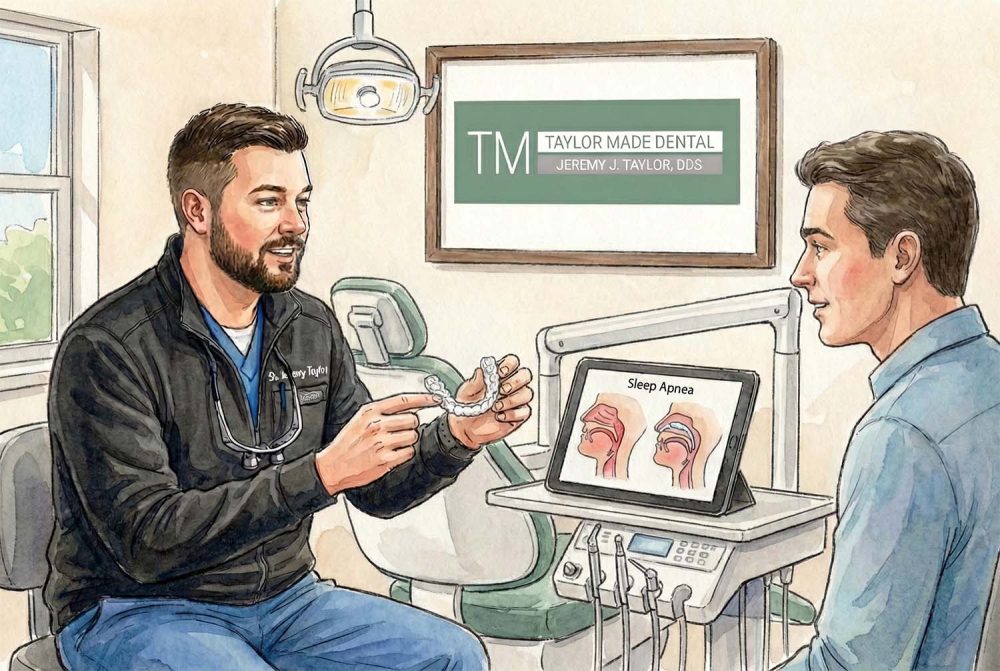
You might not think of your dentist as the first line of defense against a sleep disorder, but dentists are increasingly playing a critical role in identifying obstructive sleep apnea. At Taylor Made Dental in Boardman, OH, Dr. Jeremy Taylor has helped numerous patients discover—and treat—sleep apnea they didn’t even know they had.
What Is Obstructive Sleep Apnea?
Obstructive sleep apnea (OSA) is a condition where the soft tissues in the back of your throat collapse during sleep, temporarily blocking your airway. This causes you to stop breathing repeatedly throughout the night—sometimes hundreds of times—often without you ever fully waking up or realizing it’s happening. The result is fragmented, poor-quality sleep that leaves you exhausted even after what seemed like a full night’s rest.
OSA affects an estimated 22 million Americans, and the American Sleep Apnea Association estimates that roughly 80% of moderate to severe cases go undiagnosed. Left untreated, sleep apnea is linked to serious health consequences including high blood pressure, heart disease, stroke, type 2 diabetes, depression, and impaired cognitive function.
Why Your Dentist Sees the Signs First
Your dentist looks inside your mouth more regularly and more closely than any other healthcare provider. That unique vantage point reveals telltale signs of sleep apnea that might otherwise go unnoticed. Worn tooth surfaces from nighttime grinding (bruxism) are one of the most common red flags—many people grind their teeth as an unconscious response to airway obstruction during sleep. A scalloped tongue (one with ridged indentations along its edges) suggests the tongue is pressing against the teeth during sleep, which can indicate airway crowding.
Other signs Dr. Taylor watches for include a large tongue relative to the mouth, a narrow or high-arched palate, redness or inflammation in the throat, a small or recessed jaw, and evidence of acid reflux damage on tooth enamel. Combined with questions about daytime sleepiness, snoring, and morning headaches, these clinical findings often point toward a sleep apnea concern that the patient hasn’t discussed with their physician.
The CPAP Problem
The gold standard medical treatment for OSA is the CPAP machine—a device that delivers continuous positive airway pressure through a mask worn during sleep. CPAPs are highly effective when used consistently. The problem is that many people can’t tolerate them. Research suggests that CPAP adherence rates hover around 50%, meaning half of the people prescribed a CPAP either stop using it or use it inconsistently. Common complaints include mask discomfort, air leaks, dry mouth, claustrophobia, noise, and the hassle of traveling with the equipment.
The Dental Solution: Oral Appliance Therapy
This is where dentistry steps in with a practical alternative. Oral appliance therapy uses a custom-fitted device—similar in size to a sports mouthguard—that repositions the lower jaw slightly forward during sleep. This forward positioning keeps the airway open and prevents the soft tissue collapse that causes apnea events.
At Taylor Made Dental, Dr. Taylor works with patients who have been diagnosed with mild to moderate OSA, or who have been unable to tolerate CPAP therapy. The process is straightforward: we take precise impressions of your teeth, and a dental lab fabricates a custom appliance that fits comfortably and securely. Most patients adapt to wearing the appliance within a few nights, and many report noticing a dramatic improvement in sleep quality almost immediately.
Oral appliances are small, quiet, portable, and don’t require electricity—making them ideal for travel. They’re also covered by most medical insurance plans when prescribed for a diagnosed sleep disorder.
Taking the First Step
If you snore loudly, wake up with headaches, feel exhausted despite sleeping all night, or your partner has noticed that you stop breathing during sleep, mention it at your next dental appointment. Dr. Taylor can evaluate your mouth for physical signs of airway obstruction and, if warranted, refer you for a sleep study to confirm the diagnosis. From there, we can discuss whether an oral appliance might be the right solution for you.
Call Taylor Made Dental at (330) 758-0505 to schedule an appointment. A better night’s sleep might start in the dentist’s chair.