

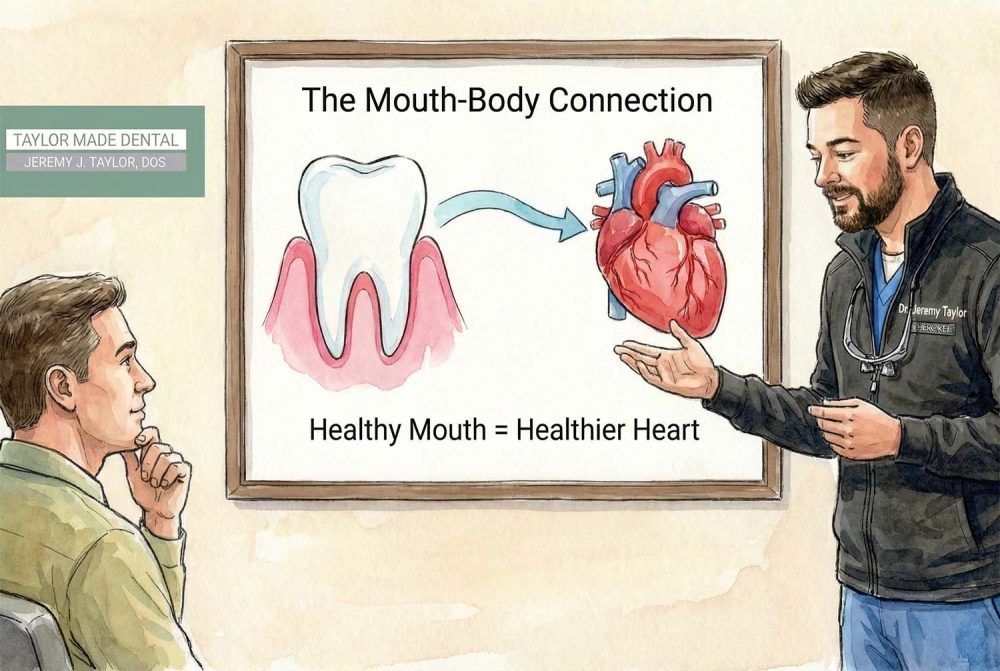
What if we told you that the health of your mouth could offer important clues about the health of your heart? The connection between oral health and cardiovascular disease has been a growing area of medical research for over two decades, and the evidence is increasingly compelling. At Taylor Made Dental in Boardman, OH, Dr. Jeremy Taylor believes that taking care of your teeth and gums is about more than just your smile—it’s about your overall well-being.
What the Research Tells Us
Multiple large-scale studies have found a statistical association between periodontal (gum) disease and an increased risk of heart disease, stroke, and other cardiovascular events. A landmark study published in the journal Atherosclerosis found that people with gum disease were nearly twice as likely to have coronary artery disease compared to those with healthy gums. Research from the American Heart Association has also noted that gum disease appears to be an independent risk factor for heart disease, meaning the link persists even after accounting for shared risk factors like smoking, diabetes, and obesity.
While researchers are careful to distinguish between correlation and causation—we can’t yet say definitively that gum disease causes heart disease—the biological mechanisms connecting the two are becoming clearer.
How Gum Disease Might Affect Your Heart
The leading theory centers on inflammation and bacteria. In periodontal disease, the gums become chronically inflamed and infected. The bacteria responsible for this infection don’t just stay in your mouth—they can enter the bloodstream through bleeding gums, a process that happens during everyday activities like chewing and brushing when gums are diseased.
Once in the bloodstream, these oral bacteria have been found inside arterial plaque deposits. Researchers believe they may contribute to the inflammatory process that narrows arteries and leads to cardiovascular events. The chronic systemic inflammation triggered by ongoing gum disease may also play a role, as inflammation is a well-established driver of atherosclerosis (the hardening and narrowing of arteries).
Shared Risk Factors
It’s also worth noting that gum disease and heart disease share many of the same risk factors: smoking, diabetes, poor diet, and chronic stress. This means that the lifestyle choices that protect your heart are often the same ones that protect your gums, and vice versa. Managing these risk factors has a compounding positive effect on both your oral and cardiovascular health.
What This Means for You
You don’t need to panic if you’ve been diagnosed with gum disease—but you should take it seriously, not just for the sake of your teeth but for your overall health. Treating and managing periodontal disease reduces the bacterial load in your mouth and lowers systemic inflammation. Regular professional cleanings, good home care (brushing twice a day and flossing daily), and prompt treatment of gum inflammation are all important steps.
If you have existing heart disease or cardiovascular risk factors, let Dr. Taylor know. It may influence how we manage your dental care and how frequently we recommend cleanings. Similarly, if we identify signs of gum disease during your exam, it’s worth mentioning to your physician—especially if you haven’t had a cardiovascular screening recently.
A Whole-Health Approach to Dentistry
At Taylor Made Dental, we see ourselves as partners in your overall health, not just your dental health. The mouth-body connection is real, and the research reinforcing it grows stronger every year. Taking care of your teeth and gums is one of the most accessible and impactful things you can do for your long-term health.
Ready to take that step? Call us at (330) 758-0505 to schedule your next appointment at our Boardman office. A healthier mouth just might mean a healthier heart.